Creusot 0.14.0
We are pleased to announce the release of version 0.14.0 of Creusot, our formal verification tool for Rust.
In this post, we highlight a small selection of new features. See the full changelog for the rest.
What's new in Creusot?
Partial orders
Previously, Creusot restricted its specification of PartialOrd to total
orders. Since version 0.13.0, we have relaxed it to allow partial orders.
(We skipped a devlog entry for 0.13.0 so let's talk about this here.)
Our previous definition of total order (OrdLogic) relied on the
comparison function cmp_log (the logic counterpart to cmp), which returns an Ordering.
// Old definition of total order
pub trait OrdLogic {
    #[logic]
    fn cmp_log(self, other: Self) -> Ordering;

    // ... (laws and other comparison operators)
}
That had the benefit of making totality an implicit consequence of the type of the function:
any two elements must compare either Less , Equal, or Greater.
With the switch to partial orders, a traditional formulation based on a
boolean comparison function ("<", aka. lt_log) becomes more natural.
A strict partial order (PartialOrdLogic) consists of a comparison function lt_log which
is irreflexive and transitive. Totality becomes another law: for all x, y,
the trijunction x < y || x == y || y < x must hold.
// (New) definition of partial order
pub trait PartialOrdLogic {
    /// `self < other` in logic
    #[logic]
    fn lt_log(self, other: Self) -> bool;

    // ... (laws (irreflexivity, transitivity) and other comparison operators)
}

// New definition of total order
pub trait OrdLogic {
    /// The order is total
    #[logic(law)]
    #[ensures(self < other || self == other || other < self)]
    fn lt_log_total(self, other: Self);
}
Interestingly, none of our existing proofs were affected by this change. Our automated provers just took it in stride.
Logic VC gen
Creusot now generates verification conditions (VCs) for snapshots, which are logic expressions embedded in Rust programs. In particular, this enhances the use of "lemma functions", a common idiom in verification tools similar to Creusot.
For example, you can encode a lemma as a logic function such as this,
which logically amounts to the proposition forall<x> hyp(x) -> concl(x):
#[logic]
#[requires(hyp(x))]
#[ensures(concl(x))]
fn lemma(x: usize) {}
Then, inside a program function you can call lemma inside a snapshot!:
fn f(n: usize) {
   snapshot!(lemma(n));
}
Creusot now translates this call to an assertion that hyp(n) (the precondition of lemma) is true
and an assumption that concl(n) (its postcondition) is true. Notably, these statements
are specialized to n, the argument of lemma, so we avoid relying on provers to
instantiate the universal quantifier in forall<x> hyp(x) -> concl(x).
It should be said that this new feature specifically enables logic functions to be used as lemma functions. Before, you could already do something similar with program functions:
#[requires(hyp(x))]
#[ensures(concl(x))]
fn lemma(x: usize) {}

fn f(n: usize) {
    lemma(n);
}
The difference is that (1) this version introduces a Rust function call, however trivial it may be, and (2) it must pass the borrow checker, which may require boilerplate to work around when all you wanted is to state some facts. In contrast, snapshots are entirely erased, so it is clear that they are there only for the sake of formal proof. Thus, these newly generated VCs for snapshots let us draw clearer boundaries between the worlds of programs and proofs.
It may seem surprising that Creusot did not already do this. This comes down to
the fact that programs and specifications are written in two separate languages,
with their own semantics, and thus with different mechanisms and motivations for generating VCs.
Without going into too much details, VCs were originally not generated for snapshot!
because it isn't necessary for soundness, but it turns out to help catch mistakes
in specifications quicker (such as out-of-bounds indexing), on top of enabling
new techniques such as that described above.
rust-analyzer integration
It is finally possible to use Go-to-definition in Pearlite specifications.
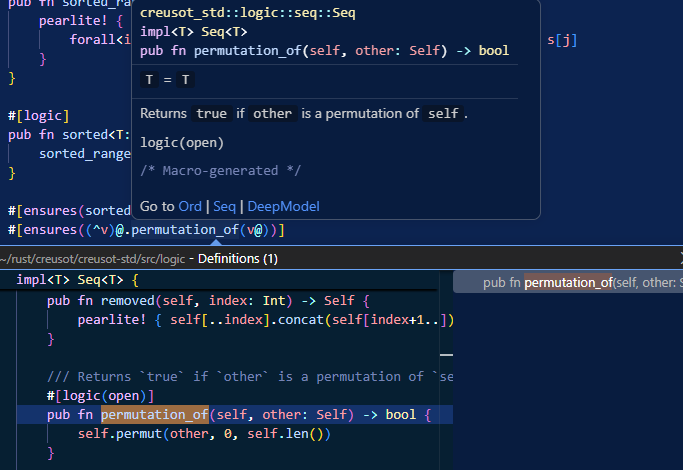
To start, we needed to make rust-analyzer expand the code of specifications.
In normal compilation, specification macros (#[requires], #[ensures],
proof_assert!, snapshot!, etc.) erase themselves, discarding their contents.
We just needed to pass options to rust-analyzer for it to expand those macros the same way Creusot does
(see our guide for the relevant rust-analyzer settings).
One worry we had was that Pearlite macros expand to not quite valid Rust code, not meant to be compiled by rustc: it passes the type checker, but not the borrow checker. Luckily for us, rust-analyzer does not do borrow checking, so it doesn't see any problem with the expanded code.
With that done, Go-to-definition did start to work, but it returned numerous irrelevant results. The problem was that the tokens produced by Pearlite macros carried spans that were too coarse-grained.
To explain it very roughly, when you activate Go-to-definition,
rust-analyzer looks for identifiers in the final AST whose span ranges over your cursor.
For example, a + b in Pearlite expands to a method call
::creusot_std::logic::ops::AddLogic::add_logic(a, b),
where every generated token carries the span of the whole expression a + b.
Hence, Go-to-definition from anywhere in that expression ends up looking up the definitions
of all of creusot_std, logic, ops, AddLogic, and add_logic.
In this case, we'd like to only look up add_logic, and only when the cursor is right next to +.
The fix is to make the token add_logic have the span of +, and
to make the other identifiers have a zero-width span,
which seems to be enough for rust-analyzer to ignore them.
Many thanks to Sarah Quiñones for figuring all this out. This fix makes navigating specifications in Creusot much more pleasant.
Thanks for tuning in. If you have any questions about Creusot, you are welcome to join our Zulip channel, or to open a discussion or an issue on the Creusot repository.